Skip to content

Sabbir Mohammad Sami web developer

ResumeDownload Resume
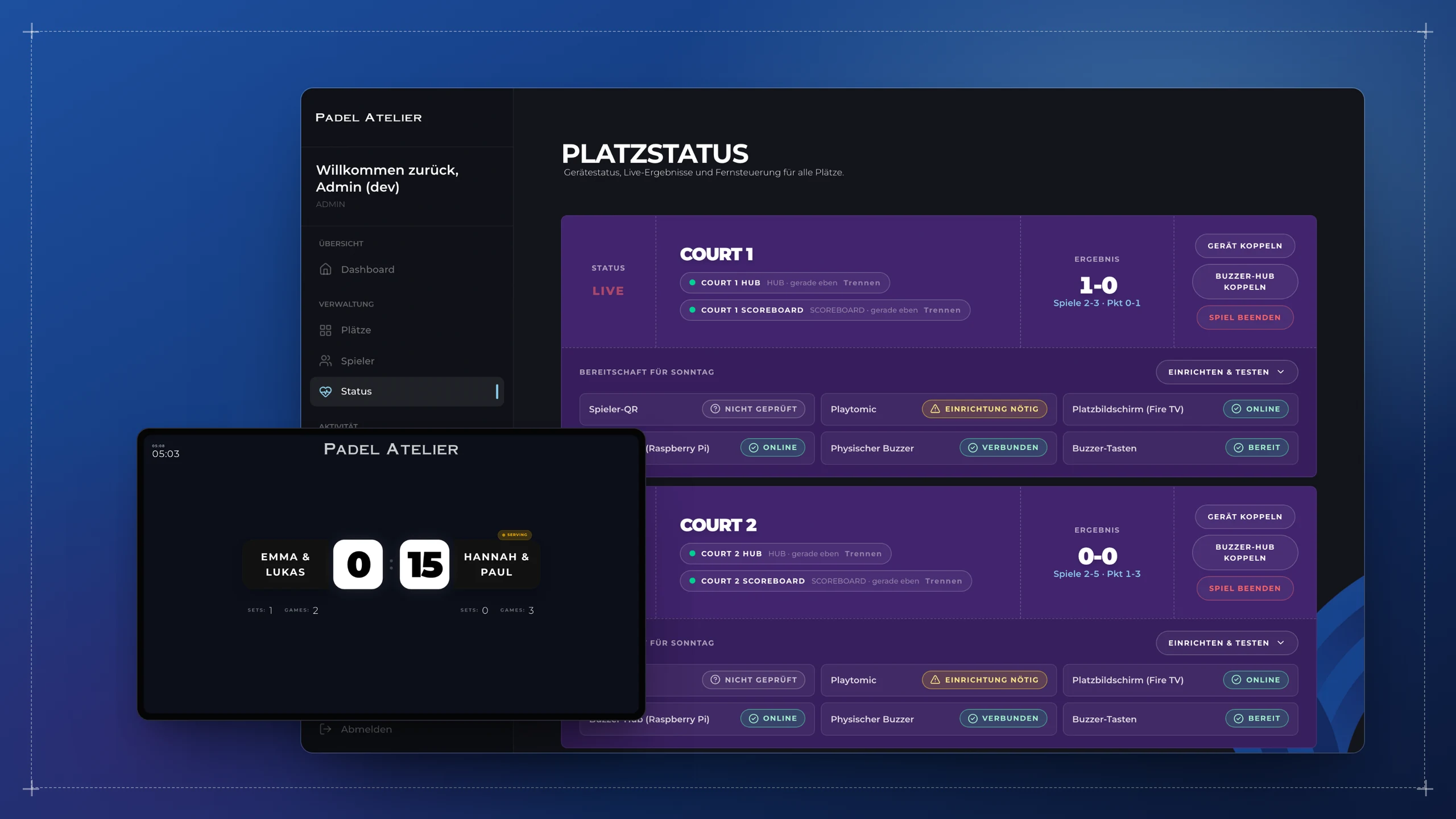
Court Health in the Padel Play dashboard on a deep blue gradient, with the live court TV scoreboard floating in front. Shown with demo data.
Index
Platform, hardware & web09 / 13

Padel Play — Court System & Website for Padel Atelier

( Discipline )

Platform, hardware & web

( Role )

Full-stack, firmware & hardware developer

( Scope )

  • System architecture
  • The NestJS API
  • Database and real-time layer
  • The staff dashboard
  • Court screen and phone setup flow
  • The Playtomic integration
  • The Vega OS TV app
  • The Raspberry Pi buzzer bridge
  • ESP32-S3 firmware and the two-board PCB in KiCad
  • The test suites and the setup guides for the venue
  • The club's website

( Stack )

  • NestJS
  • Prisma
  • PostgreSQL
  • Socket.IO
  • Next.js 16
  • Playtomic API
  • React Native (Vega OS)
  • Python (Raspberry Pi)
  • ESP32-S3 · PlatformIO
  • KiCad
  • Playwright
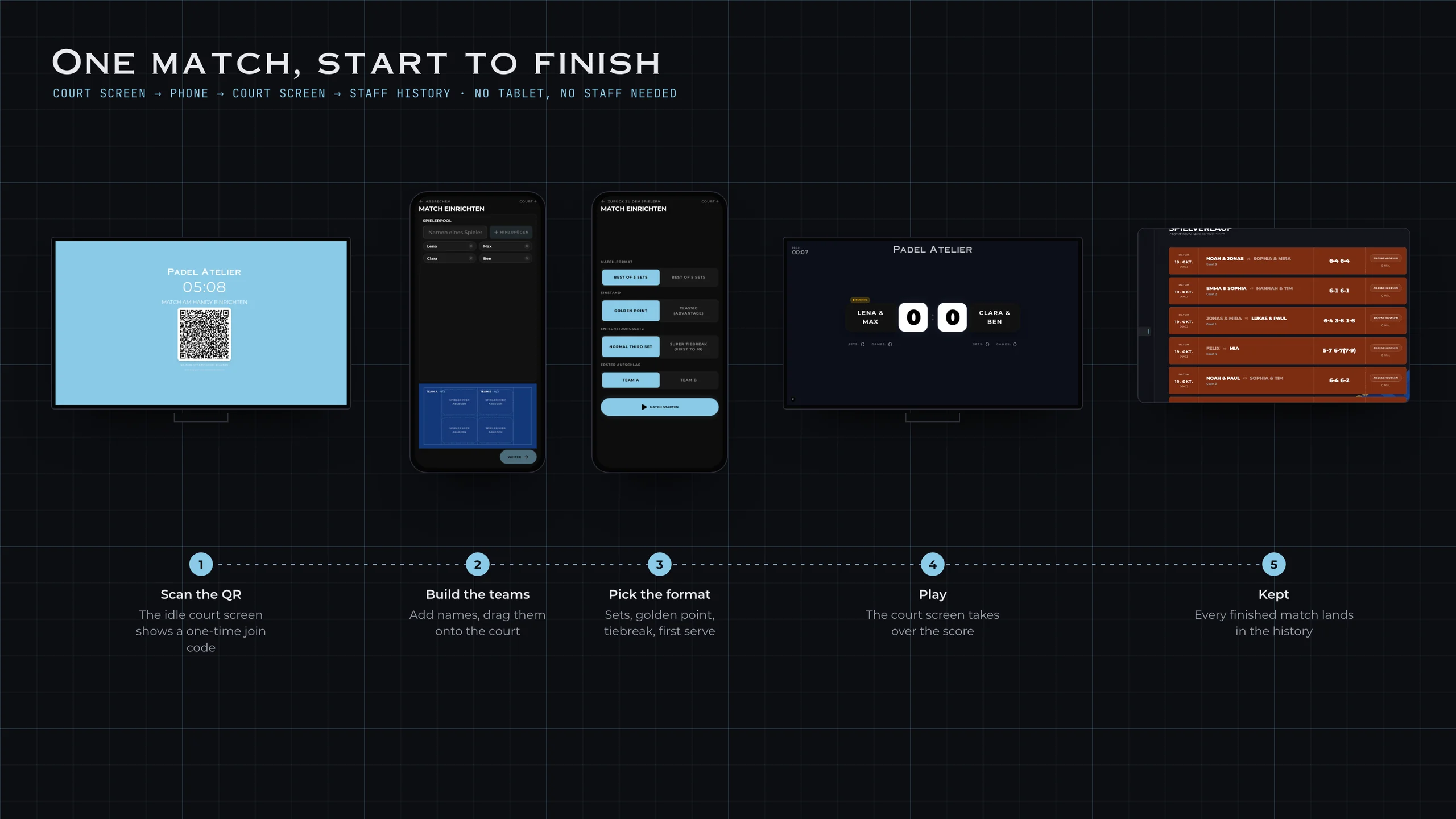
One match from start to finish: the idle court screen's QR, building the teams and picking the format on a phone, the court screen taking over, and the match in the staff history. Shown with demo data.
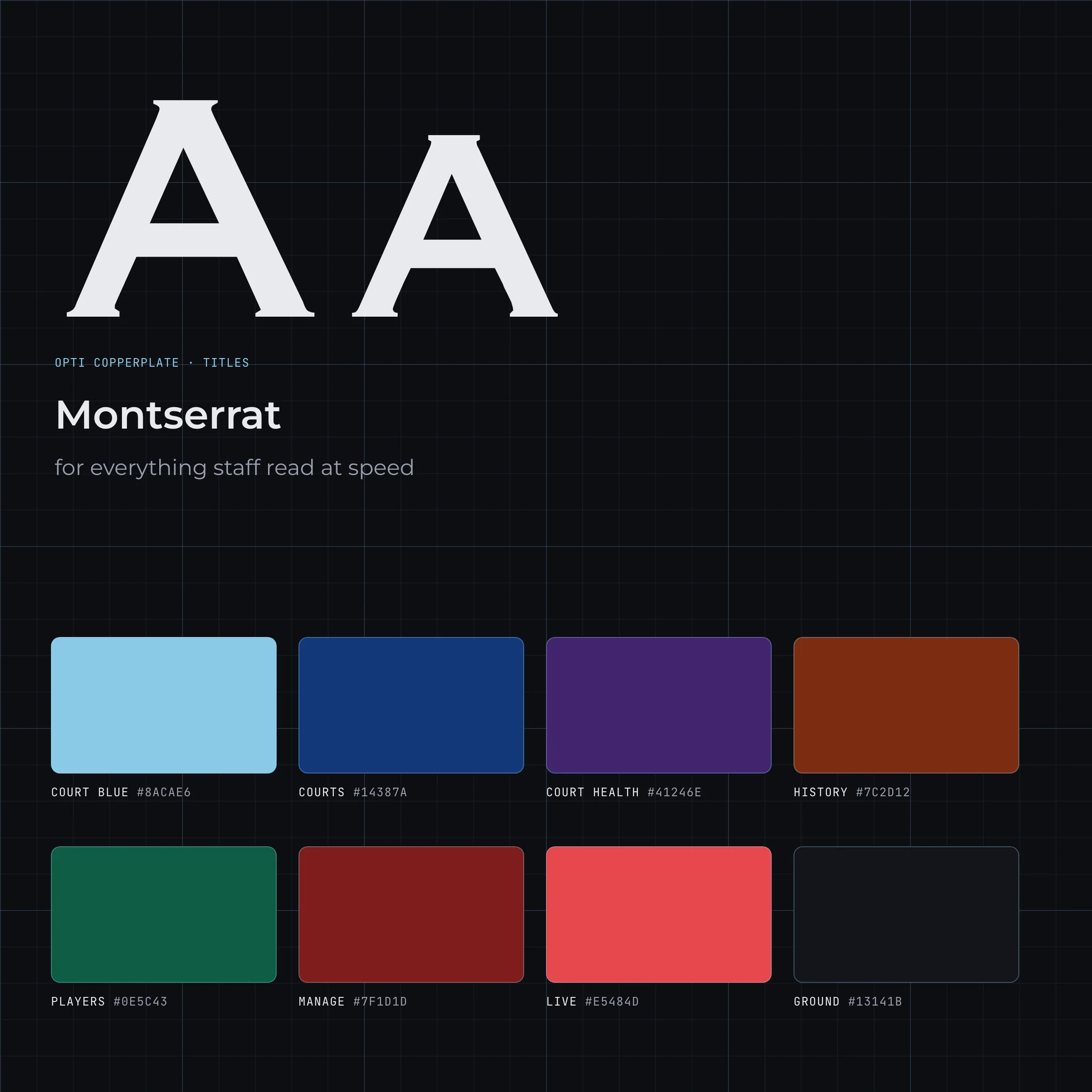
The dashboard's type and colour key: OPTI Copperplate and Montserrat, court blue and the colour of each section.
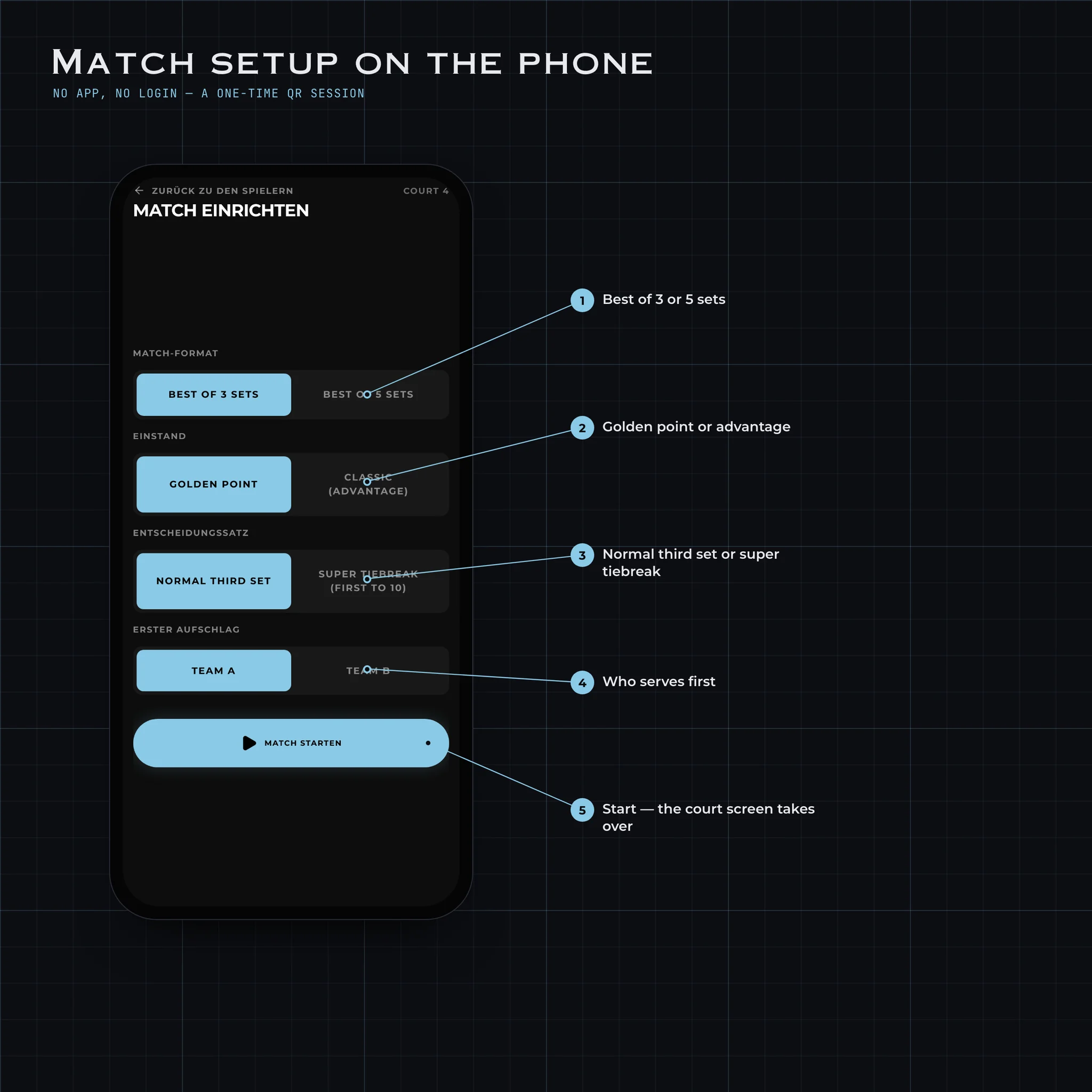
The phone's match format screen, annotated: sets, golden point or advantage, final set, first serve, and start.
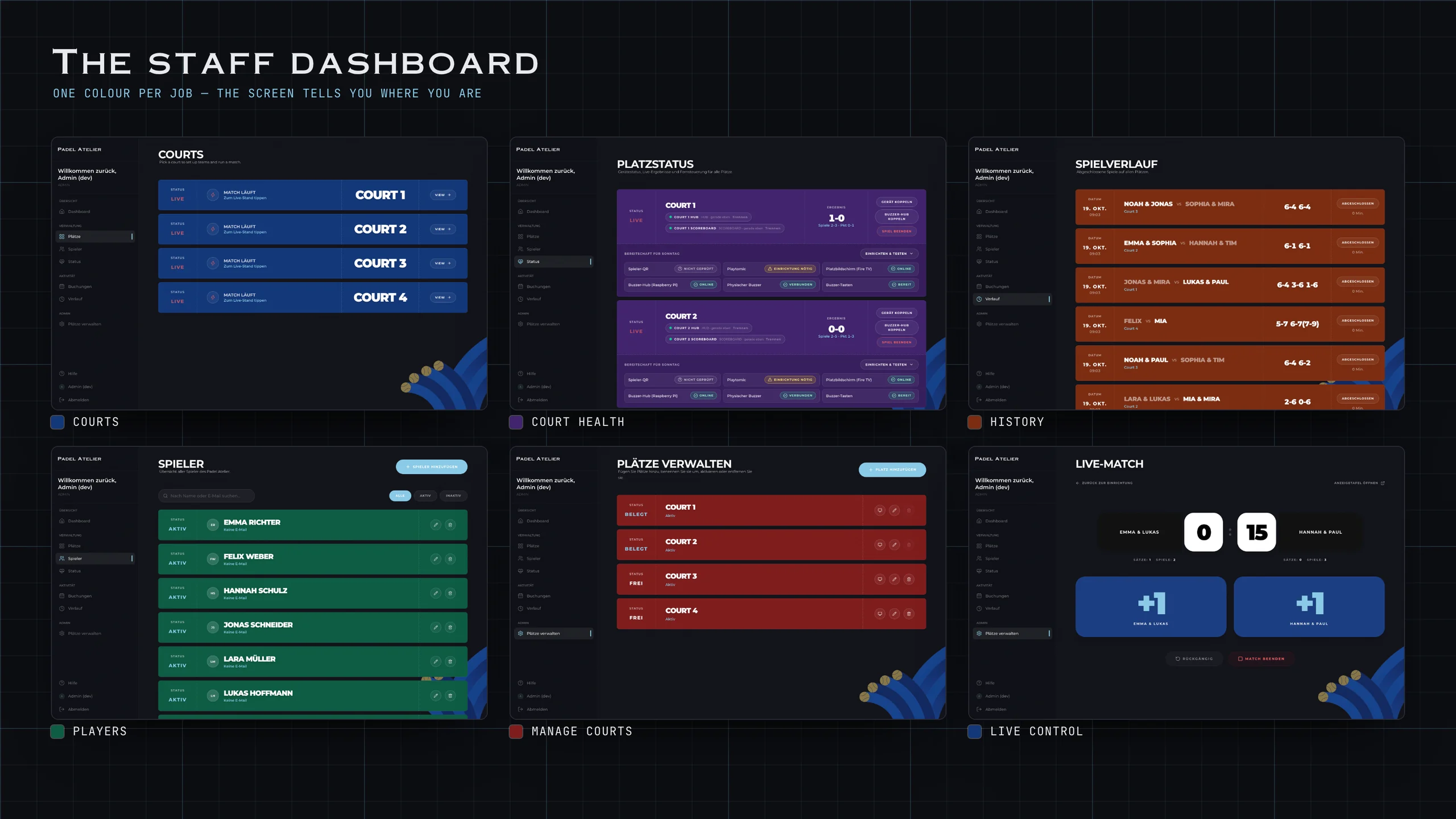
Six staff dashboard screens, each in its own colour: courts, Court Health, history, players, court management and live control. Shown with demo data.

( Brief )

Padel Atelier is an indoor padel club in Lauenburg/Elbe with three doubles courts and one singles court. Matches used to be scored by hand and courts run from a tablet. I built Padel Play to take that over: a NestJS API with PostgreSQL and Socket.IO at the centre, a Next.js dashboard for staff, a court screen for every court, a phone flow for players, and the buzzers that score the points. I also built the club's public website, atelierpadel.de — it closes this page.

( Approach )

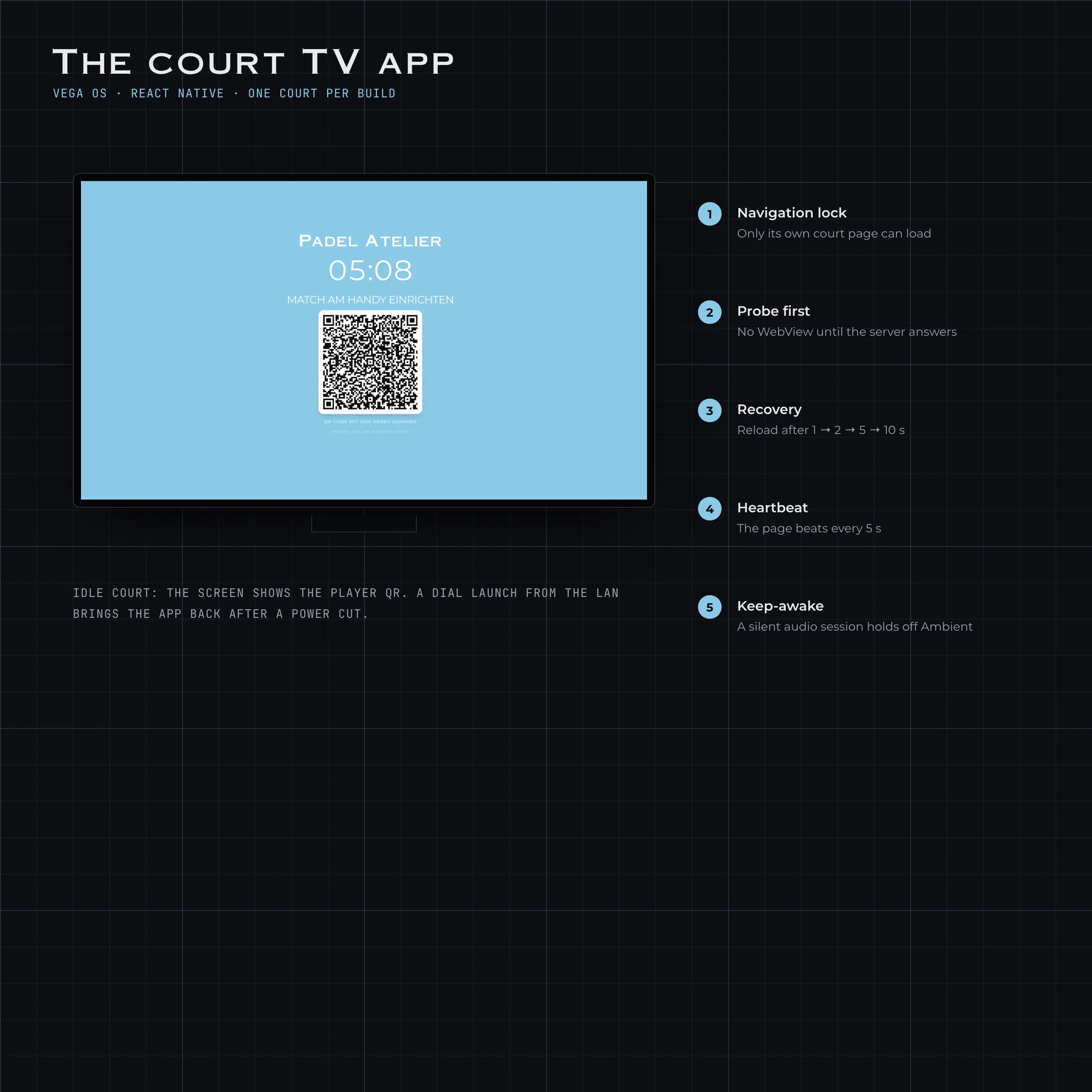
An idle court shows a QR code on its TV. A player scans it, adds names, drags them onto the court, picks the format — sets, golden point or advantage, super tiebreak, first serve — and starts; the court screen takes over the score. Points come from a buzzer on the court: an off-the-shelf USB buzzer through a Python bridge on a Raspberry Pi, or my own ESP32-S3 hub, where holding a zone 2–5 seconds scores and longer undoes. Court screens run on Fire TV Sticks with Vega OS, so I wrote a small React Native app that locks the TV to its court page, recovers it after failures, and keeps the screen awake. Bookings come from Playtomic, so the screen can count a booking down.

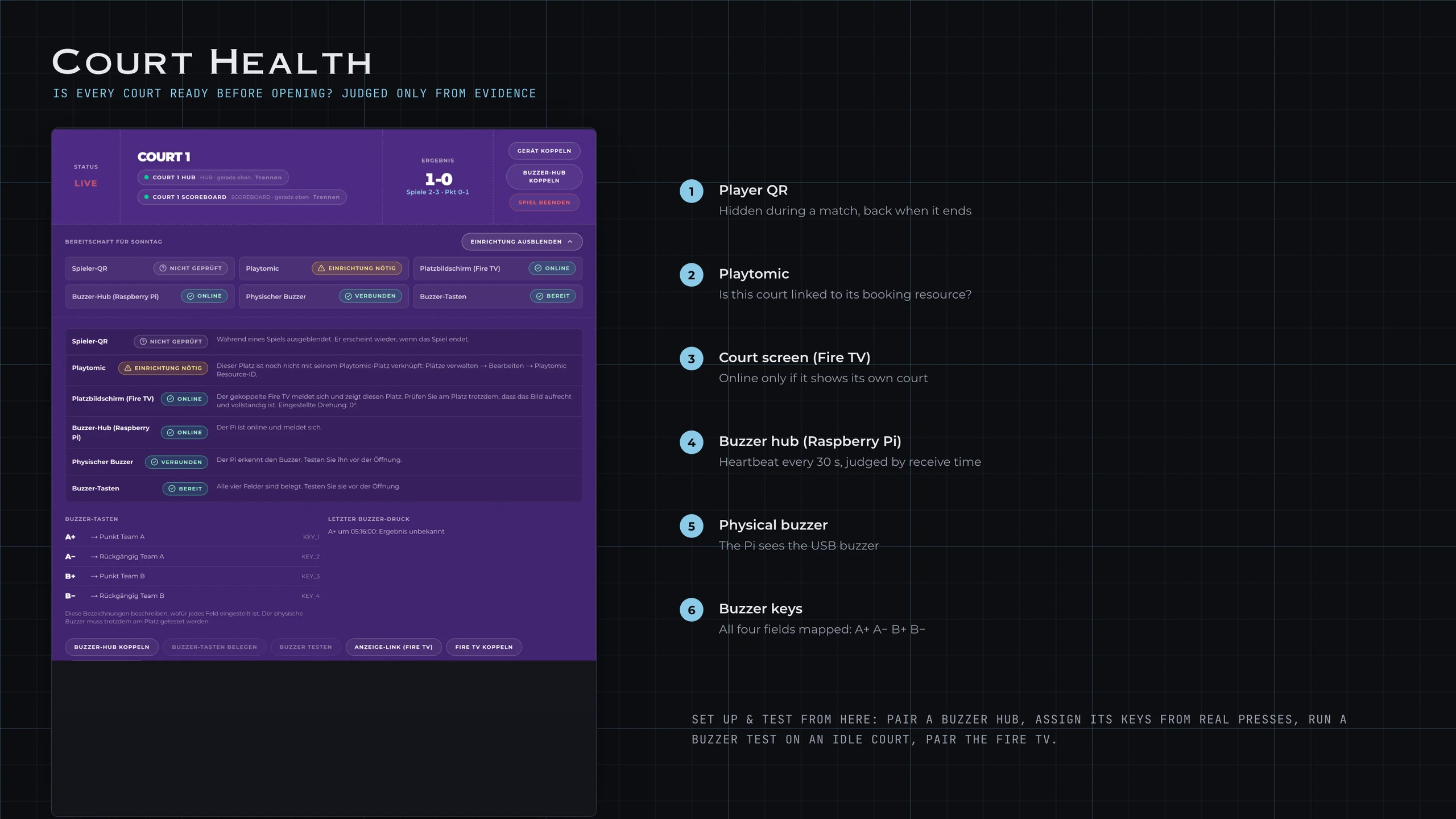
Staff get one colour per job: courts, Court Health, history, players and court management. Court Health judges every court from evidence — is the player QR live, is the court linked to Playtomic, is its screen online and showing its own court, is the Pi reporting, is the buzzer connected and are its four keys mapped — and has the tools to pair and test each piece before opening.
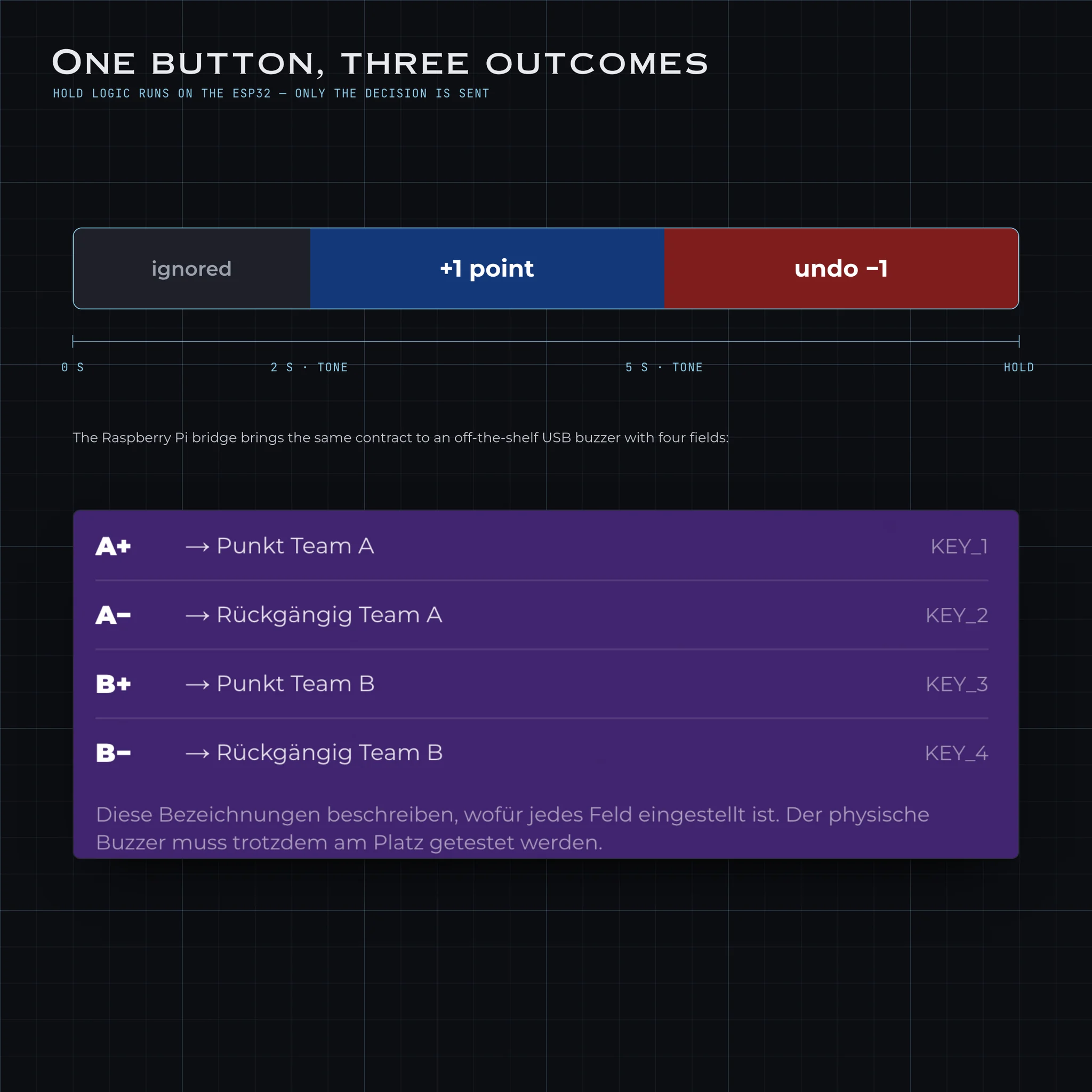
The buzzer's hold logic — under 2 seconds ignored, 2 to 5 seconds a point, longer an undo — above the four-key map of the USB buzzer.
The court TV app on an idle court showing the player QR, with its five safeguards: navigation lock, probe first, recovery, heartbeat and keep-awake.
Court Health for one court, annotated: player QR, Playtomic link, court screen, buzzer hub, physical buzzer and buzzer keys. Shown with demo data.

( Challenge )

Everything at a court has to recover on its own — nobody is there to press a remote. Devices are scoped to their own court by token, so a buzzer or screen can never touch another court; the TV app reloads its page after failures and holds off the screensaver; matches left running are closed by the next booking's players; and the same score must reach the TV, the dashboard and the phone at once. It is held together by hundreds of automated tests: backend unit and end-to-end suites, dashboard unit tests and more than 400 Playwright tests across the dashboard, court screen and phone.

( Responsibilities )

System architecture, the NestJS API, database and real-time layer, the staff dashboard, court screen and phone setup flow, the Playtomic integration, the Vega OS TV app, the Raspberry Pi buzzer bridge, ESP32-S3 firmware and the two-board PCB in KiCad, the test suites and the setup guides for the venue, and the club's website.
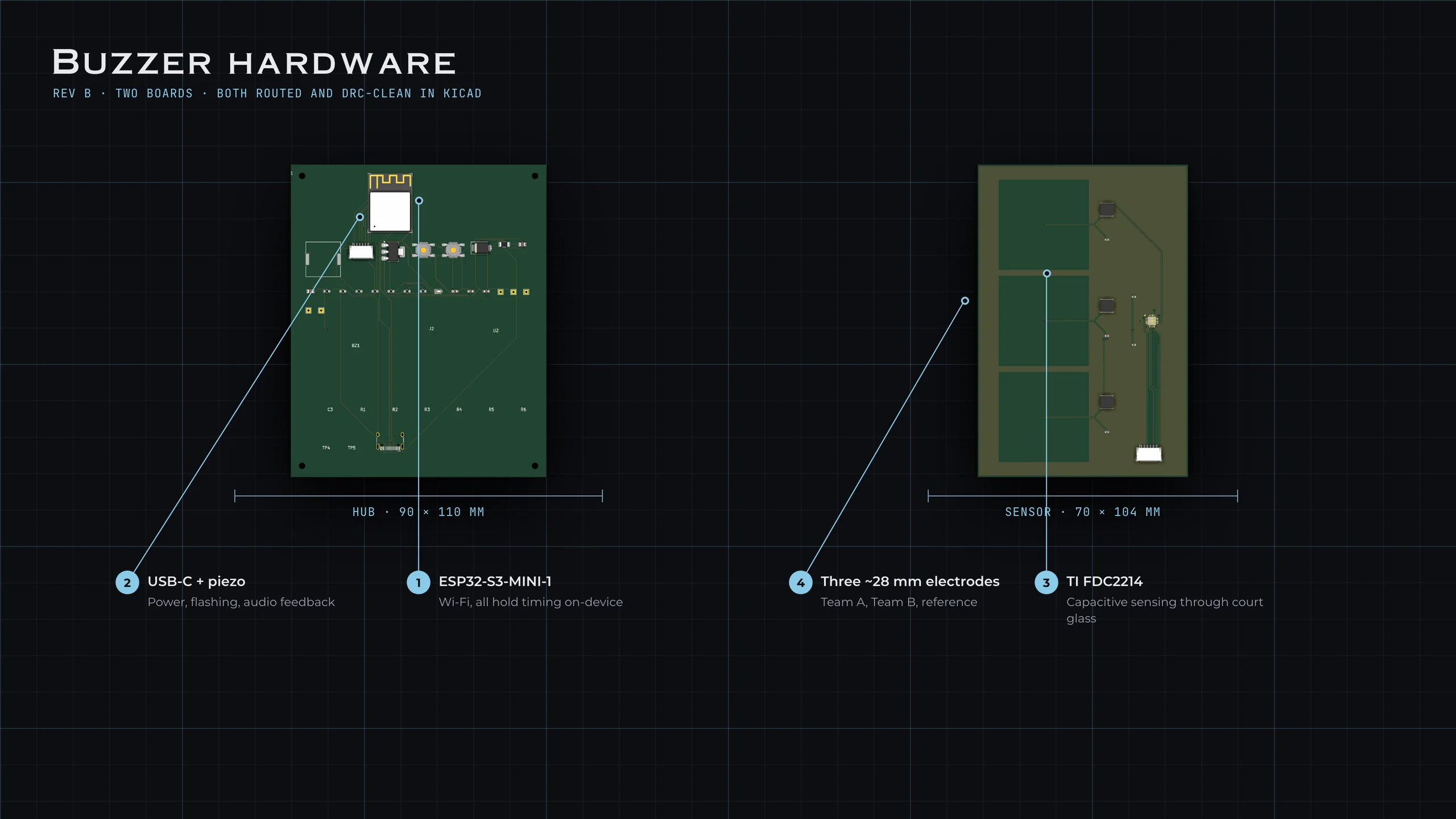
The two buzzer boards rendered from KiCad with dimensions: the 90 × 110 mm ESP32-S3 hub and the 70 × 104 mm FDC2214 sensor board with its three electrodes.

( The club website )

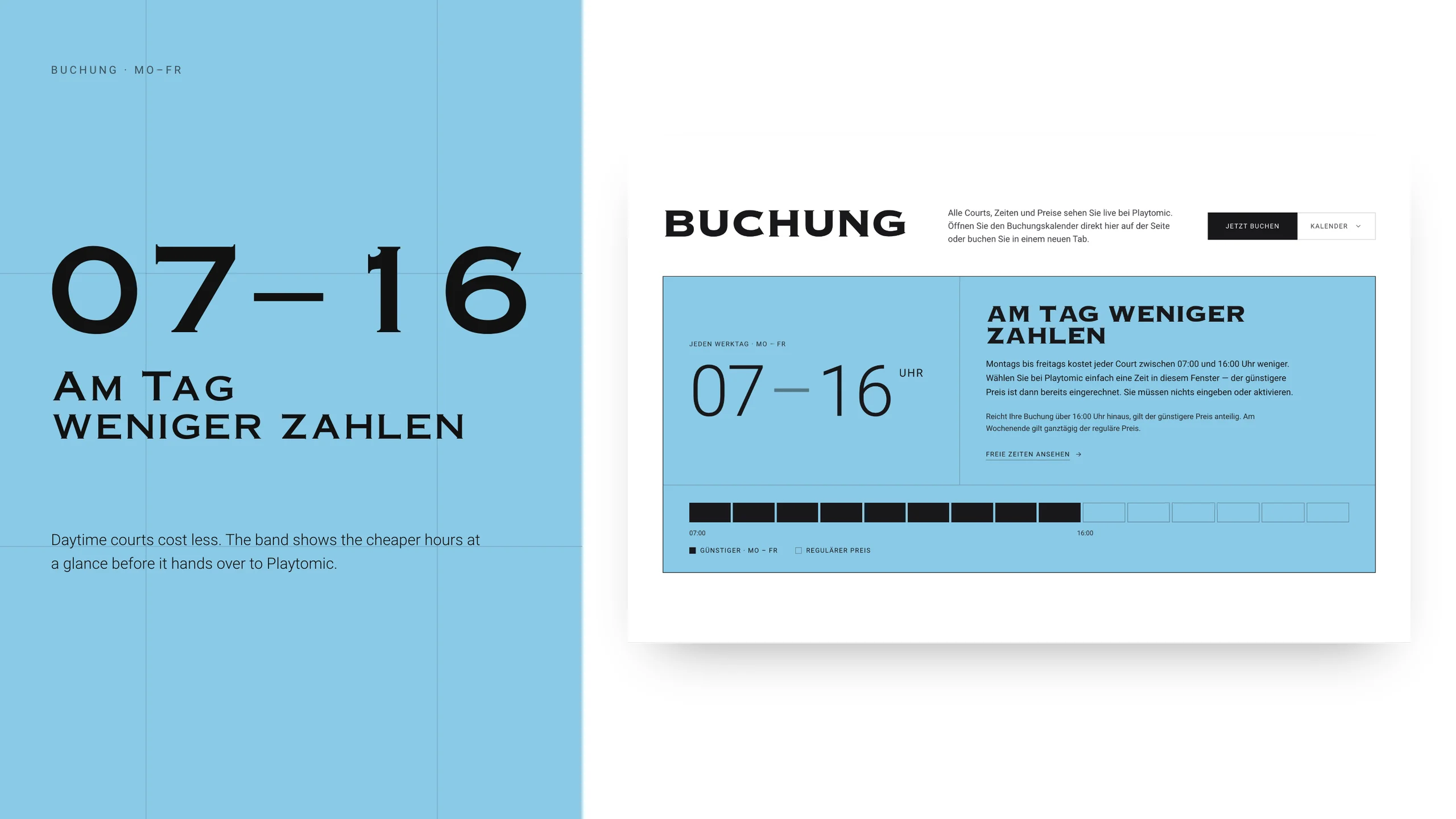
Padel Atelier's four indoor courts in Lauenburg/Elbe are found and booked at atelierpadel.de. The German site is built around the club's own look — the court blue, OPTI Copperplate and a thin grid running through every page — and its home page does the main job: the Playtomic booking calendar, with the cheaper weekday hours from 07:00 to 16:00 shown at a glance.

atelierpadel.de

( What’s in it )

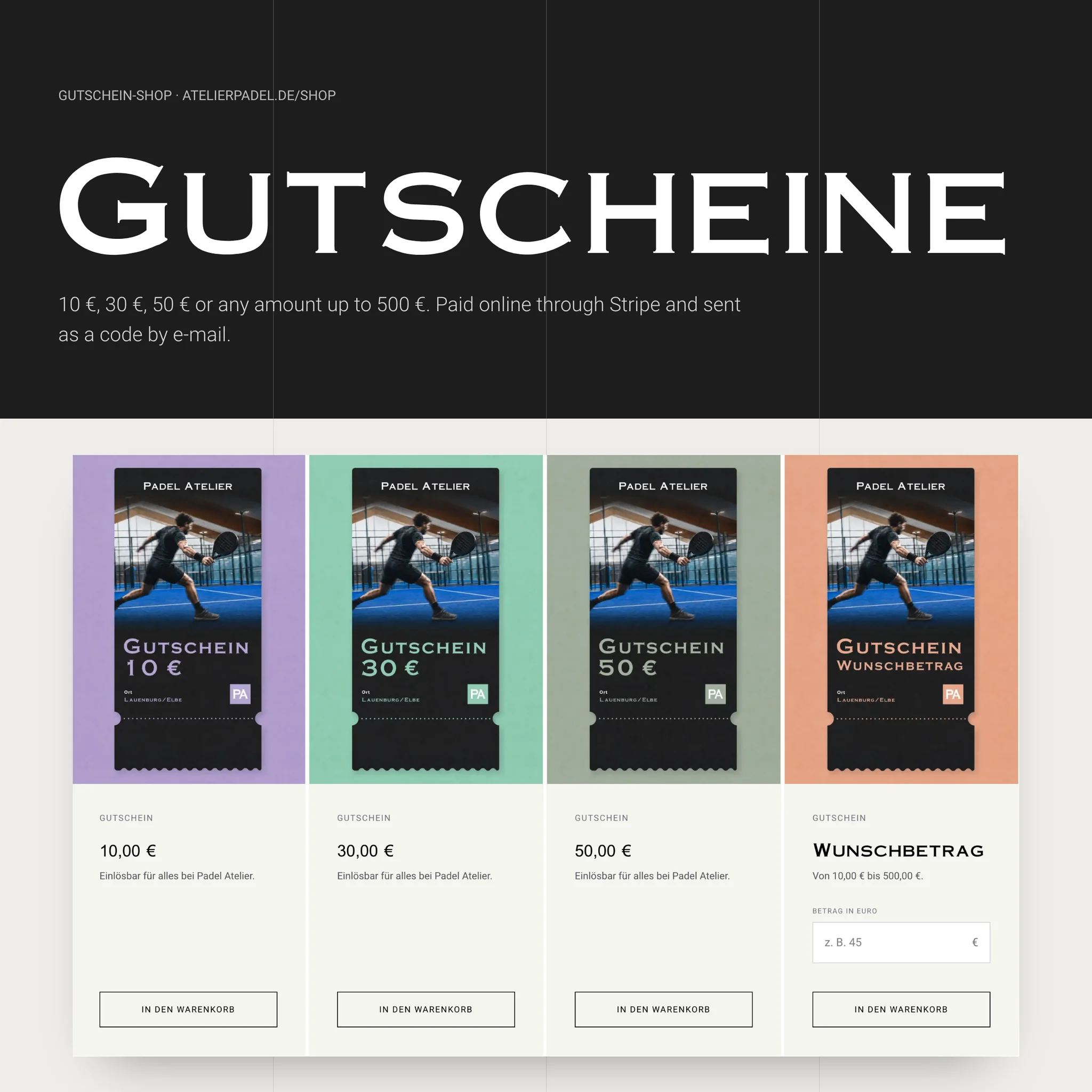
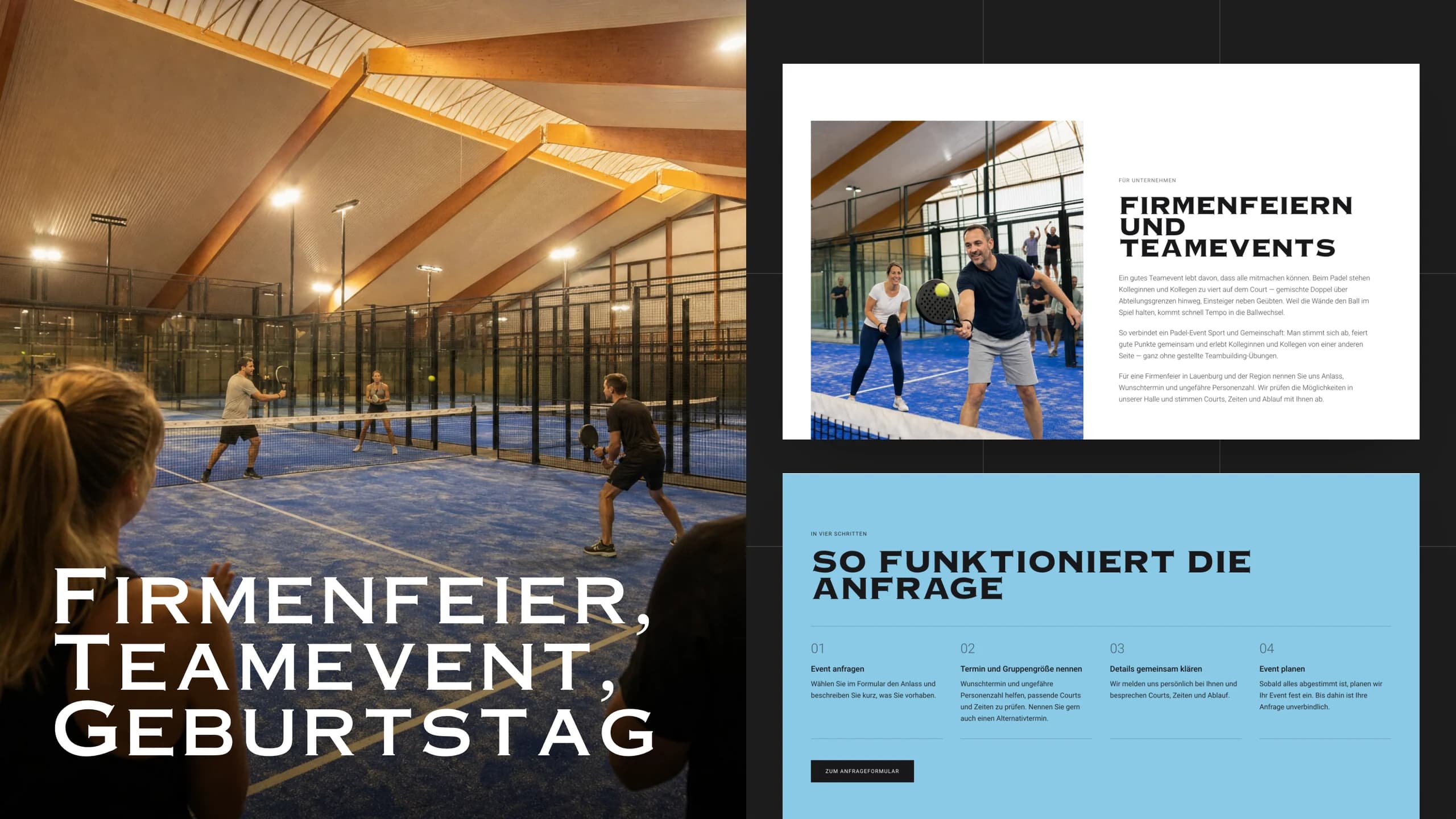
Around it: a Gutschein shop for vouchers of 10, 30 or 50 € or any amount up to 500 €, paid through Stripe and sent as a code by e-mail; Events & Feiern with a request form for company parties, team events and birthdays; partner pages for Epassi, Wellpass and Wellhub and the club's own membership; directions from the surrounding towns; a magazine; a newsletter with double opt-in through Brevo; and the German legal pages. GSAP and Lenis carry the motion.

Role: Designer & Frontend Developer. Stack: Next.js 16, GSAP, Lenis, TanStack Query, Stripe, Brevo, Playtomic.
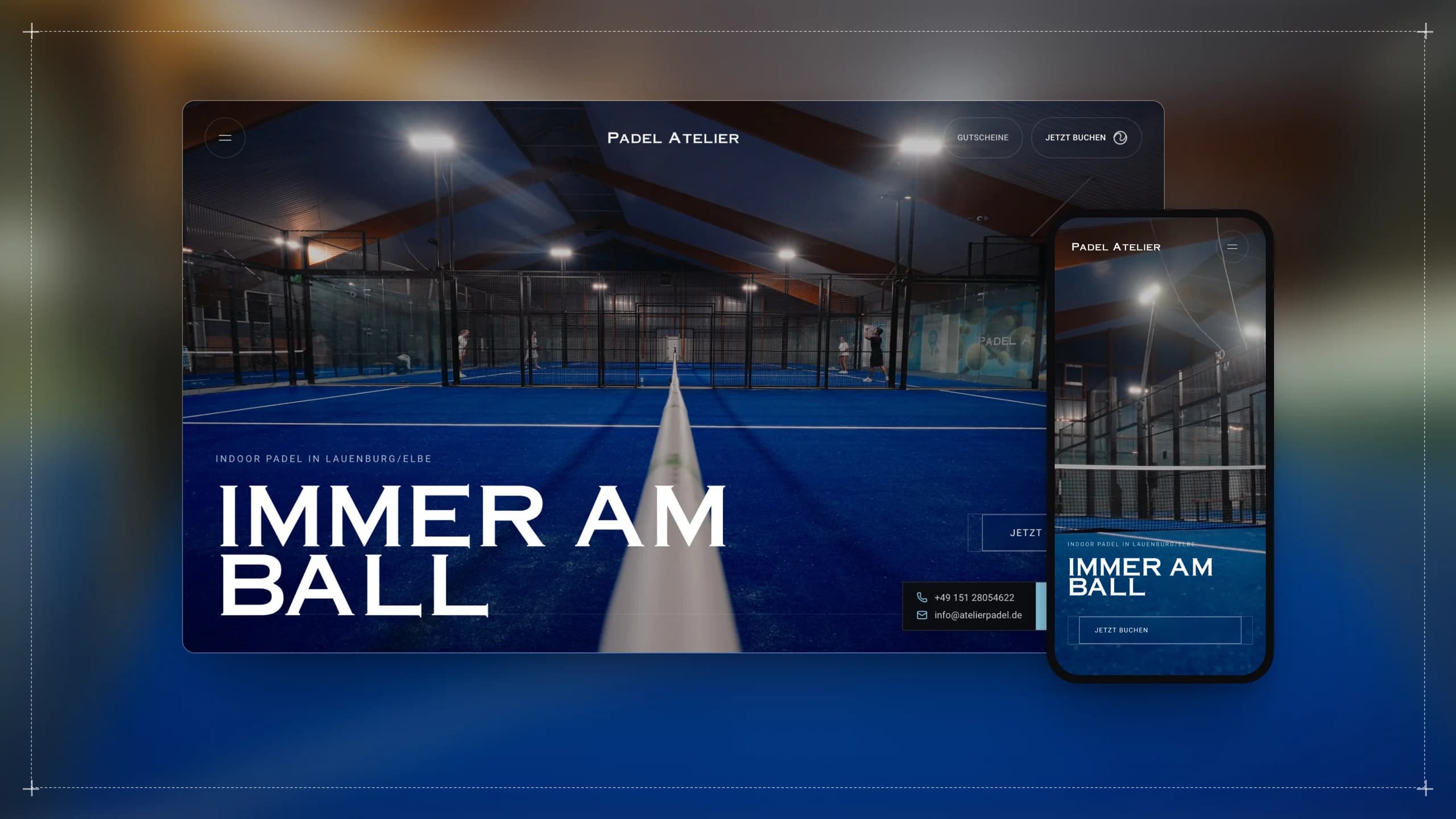
The Padel Atelier home page — “Immer am Ball” over the night court — on a blurred court-blue ground, with the same page on a phone.
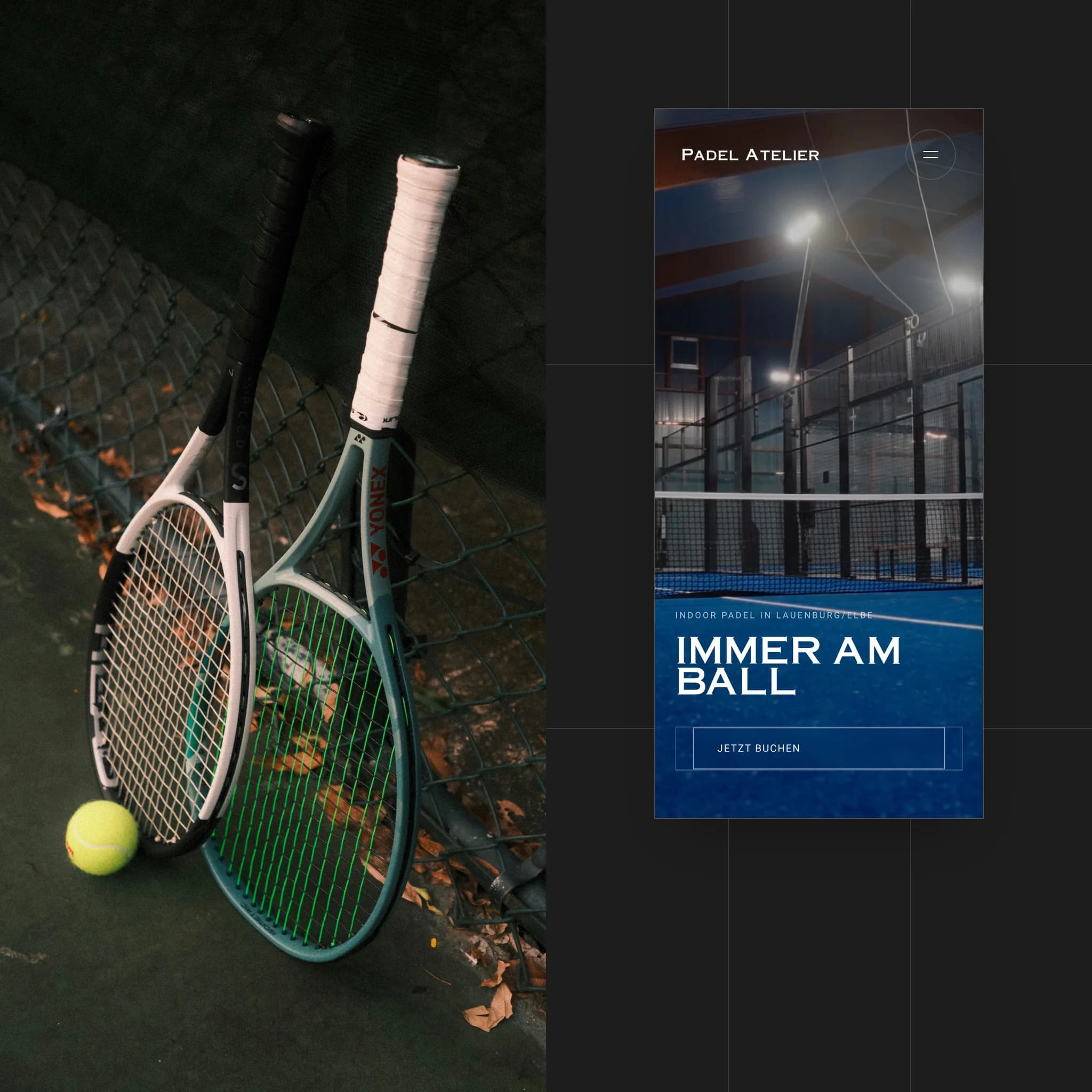
A spread: two rackets on the court beside the Padel Atelier home page on a phone.
“Gutscheine” in Copperplate above the voucher shop: 10 €, 30 €, 50 € and a chosen amount, each with its add-to-cart button.
A spread: “07–16 — Am Tag weniger zahlen” in court blue beside the booking section with its daytime price band.
A spread: a group playing at the club under “Firmenfeier, Teamevent, Geburtstag”, beside the events page and its four-step request.
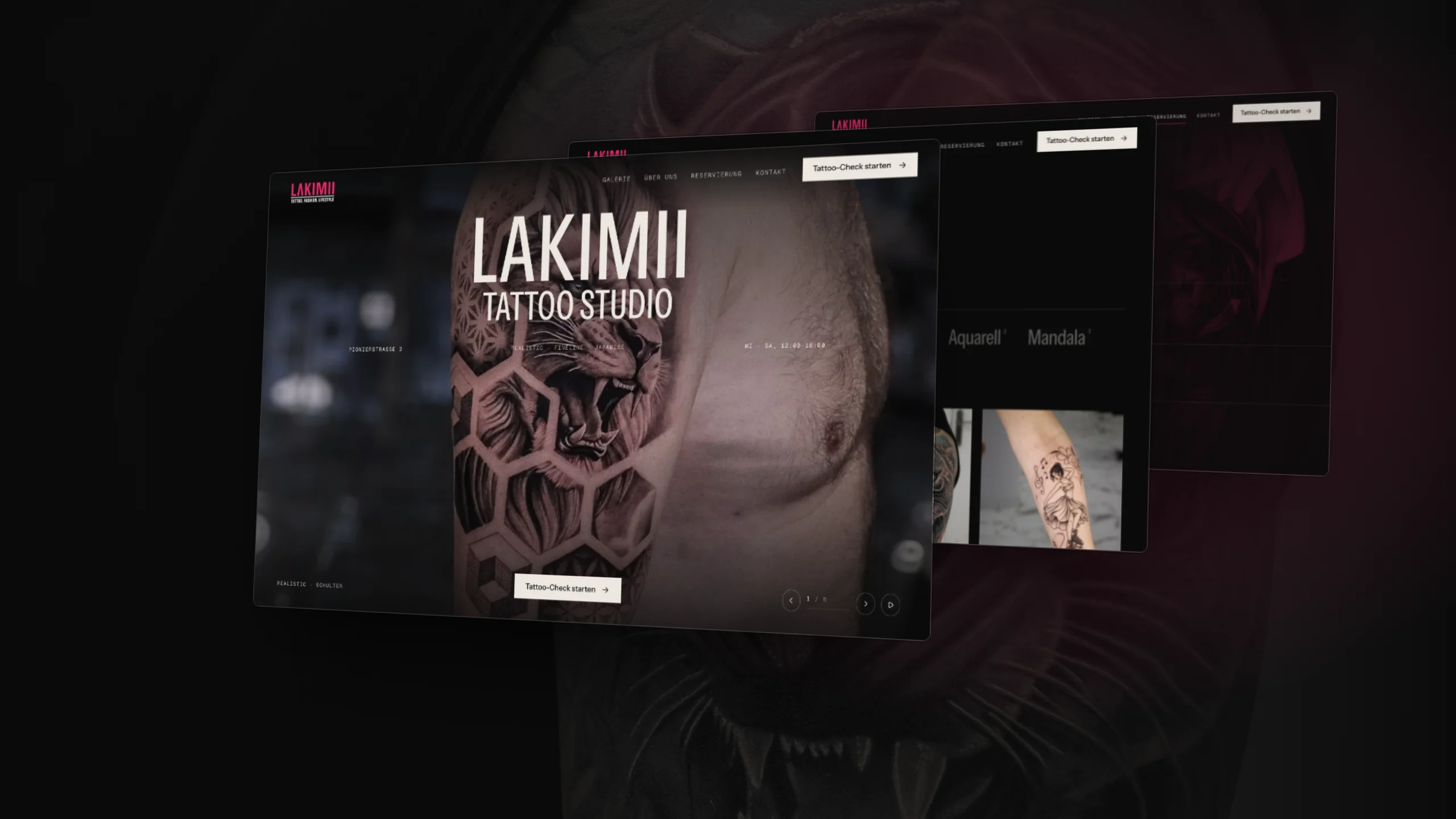
(Next project)LakimiiLakimii Studio — Tattoo Studio Website & Tattoo-Check

Experience

( 03 roles — 2+ years )

Full-stack developer in Dhaka, Bangladesh. Building for clients in Germany and Bangladesh since 2022.

  1. (01)

    August 2025 — Present

    Full-Stack Developer

    Susko GmbH · Full Time · Remote

    • Developed and enhanced an AI-powered SaaS and social media automation platform — AI content, image and video generation, automated scheduling and publishing, multi-account and content-team management, Meta, Instagram and Google integrations, WhatsApp-based content generation and scheduling, admin controls and subscription management.
    • Built a full-stack Padel court management and automation system that connects physical court hardware to a real-time web dashboard — court and player management, game control and live scores over WebSocket — and worked on the sensor electronics, PCB design, footprint verification, Gerber validation and JLCPCB manufacturing.
    • Built and maintained automation workflows with n8n, webhooks, APIs and external service integrations that take manual steps out of business processes.
    • Delivered 40+ production websites and full-stack applications for German clients across industries in React, Next.js and TypeScript — shop management, review management and automation, fundraising platforms, menu management, QR code generation and other custom business tools.
    • Optimized backend performance across production applications — database queries, API paths, data processing and Redis-based workflows — for faster, more responsive apps.

    Next.js · React · TypeScript · Node.js · Python · Prisma · Redis · WebSocket · n8n · OpenAI

  2. (02)

    March 2024 — May 2025

    Software Developer

    Bangladesh Associate of IT Solutions · Full Time · On-site

    • Developed a full-stack inventory management system tracking products, sales, payments, returns, waste products, customer ledgers and SMS notifications, in React, TypeScript, Express and MySQL.
    • Scaled an accounting management platform from a single-client application into a multi-user system, with financial dashboards, journal entries, transaction management, reporting and data visualization.
    • Deployed and maintained web applications on cPanel and VPS servers — production deployments, domain configuration, server setup and troubleshooting.
    • Delivered websites for schools, madrasas and other organizations, turning client requirements into responsive, production-ready web applications.
    • Developed and redesigned production and company portfolio websites in React, Next.js and TypeScript, with a focus on responsive design and user experience.

    React · Next.js · TypeScript · Express · MySQL · Tailwind CSS · cPanel · VPS

  3. (03)

    November 2023 — April 2024

    Full-Stack Developer

    Diginie IT · Internship · Remote

    • Completed a remote internship as a full-stack developer, building and maintaining client web applications in Next.js, TypeScript and Tailwind CSS.
    • Turned designs into responsive pages that held together on every screen size, and kept existing client sites running.

    Next.js · TypeScript · Tailwind CSS · GitHub

About

( Dhaka, Bangladesh )

Sabbir Mohammad Sami — full-stack web & app developer at Susko GmbH, building for the web since 2022.

Sabbir Mohammad Sami, smiling and looking off to the side, seated on a white block in a black sweater — black-and-white studio portrait

I’m a full-stack developer from Dhaka who cares about the part people actually touch — unusual layouts, careful CSS, motion that means something — and about the code underneath being just as clean.

( Story )

I grew up in Dhaka and studied arts and humanities at Kabi Nazrul Government College. Alongside my studies I joined a web development course, and that is where the real growth started — surprise. Alongside work, I am now in my third year of Honours in Economics at National University.

My first website was a tourism site about the place I most wanted to visit. I built it in class 10.

Today I build AI products, automation and client platforms at Susko GmbH, after two years of shipping inventory, accounting and client sites at BAITS. What I am after has not changed: interfaces that look good and back-ends that run smoothly, from the same pair of hands.

Honest, down to earth, and fond of hard work. My inbox is always open — for a project, or just to say hi.

  1. ( Education )

    1. Kabi Nazrul Government College

      • Arts and humanities
      • Dhaka, Bangladesh
    2. National University, Bangladesh

      Session 2023–2024 · Now

      • Honours in Economics — 3rd year
      • Department of Economics
  2. ( Co-curricular )

    —

    Bangladesh National Cadet Corps (BNCC)

    • 1 No Battalion, Ramna Regiment
    • Rank: Cadet Corporal
  3. ( Languages )

    Bangla, English, Hindi

    • Bangla — native
    • English — comfortable
    • Hindi — fluent

( Skills )

Expertise
React · Next.js · JavaScript · TypeScript · MongoDB · Bootstrap · Tailwind CSS · shadcn/ui · GitHub · Figma
Comfortable
Flutter · Dart · MySQL · Mongoose · Express · TanStack Query · Firebase · React Router · Photoshop
Familiar
Zod · Framer Motion · GSAP · JWT · Axios · CORS · Stripe · Vercel

( Questions )

Who is Sabbir Mohammad Sami?

Sabbir Mohammad Sami (S M Sami) is a full-stack web and app developer from Dhaka, Bangladesh. Since August 2025 Sami has worked as a Full-Stack Developer at Susko GmbH in Germany, after building inventory and accounting platforms at Bangladesh Associate of IT Solutions (BAITS). Sami has been building for the web since 2022.

What does Sabbir Mohammad Sami build?

Sami builds websites, web apps, mobile apps and AI products end to end: company and restaurant websites, booking and management platforms, an AI social media platform (Kocial), an AI review manager (ReviewSync) and a Flutter money app (Sompi). That includes 40+ production websites for clients in Germany and Bangladesh.

Which technologies does Sami work with?

Sami works across the MERN stack — MongoDB, Express, React and Node.js — and with Next.js, TypeScript, Tailwind CSS, MySQL, PostgreSQL, Prisma and Redis. Mobile apps are built in Flutter and Dart. AI features use the OpenAI API, n8n automations and webhooks, and motion uses GSAP.

Does Sami build mobile apps with Flutter?

Yes. Sami builds cross-platform apps in Flutter and Dart. Sompi, Sami’s own money tracker, runs on Android, iOS, the web and the desktop from one Flutter codebase, with Riverpod for state and an encrypted SQLite store, so every account and transaction stays on the device.

Does Sami build AI products?

Yes. At Susko GmbH Sami builds AI SaaS: Kocial writes captions, generates images and publishes to Facebook and Instagram for agencies, and ReviewSync answers Google reviews in a business’s own voice. Sami also builds n8n workflows that connect AI models to business tools.

How can I hire Sami as a web or app developer in Dhaka?

Email smsami.dev@gmail.com or use the contact form on this site with a short note about the project. Sami works with clients in Dhaka, across Bangladesh and abroad — remotely for companies in Germany — and replies in English or Bangla.

( Contact )

Contact

( Available for projects )

Based in Dhaka, Bangladesh (GMT+6). Happy to talk in English, Bangla or Hindi.

Let’s work together.

Have an exciting project you need help with? Send me an email, give me a call, or write below — a project, a question, or just to say hi.

( Write to me )

* Required